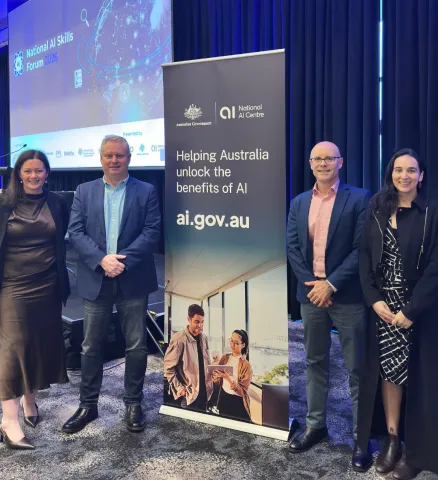
- FSO launched the Skills Accelerator-AI 2.0 – the next phase of a national community that has grown to include more than 1,600 people across 600 organisations. This phase focuses on connecting people, scaling proven AI approaches and helping organisations learn from each other.
- Good Things Australia announced a partnership with the National AI Centre to help upskill the Australians most at risk of being left behind in the age of AI.
- The OECD shared global perspectives on workforce AI investment, including Finland's whole-of-society model.
- FSO signed a formal agreement with Mexico's Institute for the Future of Education on how AI is reshaping early-career work.
Key themes
Adoption doesn’t always mean capability
More Australians are using AI – but using it effectively is a different question. The real goal is creating value. Leaders were encouraged to start with the outcome they want, then work back to the skills needed to get there.
Job loss fears don't match the data
Nobody knows exactly what jobs will look like in 10 years, and that uncertainty is real. AI sits across every sector, so it will play a role in the shifting nature of work. But senior economists from Australia, the OECD and the Department of Employment and Workplace Relations agreed: overall employment remains strong. What stood out across the two days is that human judgement and trust are becoming more valuable, not less.
This is a people challenge, not a technology challenge
The promise of AI is clear, but the long-term destination is not. Across two days, a consistent message emerged: skills like adaptability, professional judgement and critical thinking matter more in an AI-enabled world. Getting AI right means bringing all Australians along, not just those already connected to big employers.
The skills ecosystem needs to move faster
Updating a qualification traditionally takes 18 to 24 months. That's too slow for a field where content can feel out-of-date before it even reaches the learner – so we need to adapt. Modular, flexible credentials offer a real opportunity, but we need to move quickly to make them work alongside longer-term education reform.
Small businesses are key to national impact
Around a third of Australia's economy is made up of small businesses. About 43% of Australian small and medium businesses already use AI in some form – but what holds most back isn't the technology. It's confidence, trust and not knowing where to start. Building AI capability across this cohort is one of the most important things we can do for national productivity.