
You’ve got an hour back. Now what?

Lee Hickin, Executive Director, National AI Centre
Lee Hickin
Executive Director, National AI Centre
18 September 2026
First published
18 September 2026
If we’re going to get AI right, let’s start with the value we want it to create.

More than half of Australian small businesses expect AI to help them become more efficient or scale more effectively, according to NAB’s August 2026 Business Insights

But efficiency can mean a lot of things. More work? More customers? More revenue? Productivity in some form?

For me, there’s a simpler question: if AI gave you an hour back in your working week, what would you do with it?

More time with customers? Getting to the project that’s been sitting on the list since 2023? Developing a new product? Fixing something in the business that could work better?

At the NAB Small Business Summit in August, I joined Andrew Blair, Director of Queensland-based Bella Manufacturing, on a panel. Andrew’s business manufactures custom mobile catering and promotional vehicles, from food trucks and trailers to carts, kiosks and golf carts, and uses AI across marketing, sales, operations and logistics. He summed up the value pretty neatly:

"The real value isn’t the technology. It’s the time it gives back."

That stuck with me.

Because when we talk about the value of AI, the conversation can quickly become about the technology itself. The tools. The features. How much faster something can be achieved and the money it might save.

For a business, the more useful conversation starts with what you want to achieve.
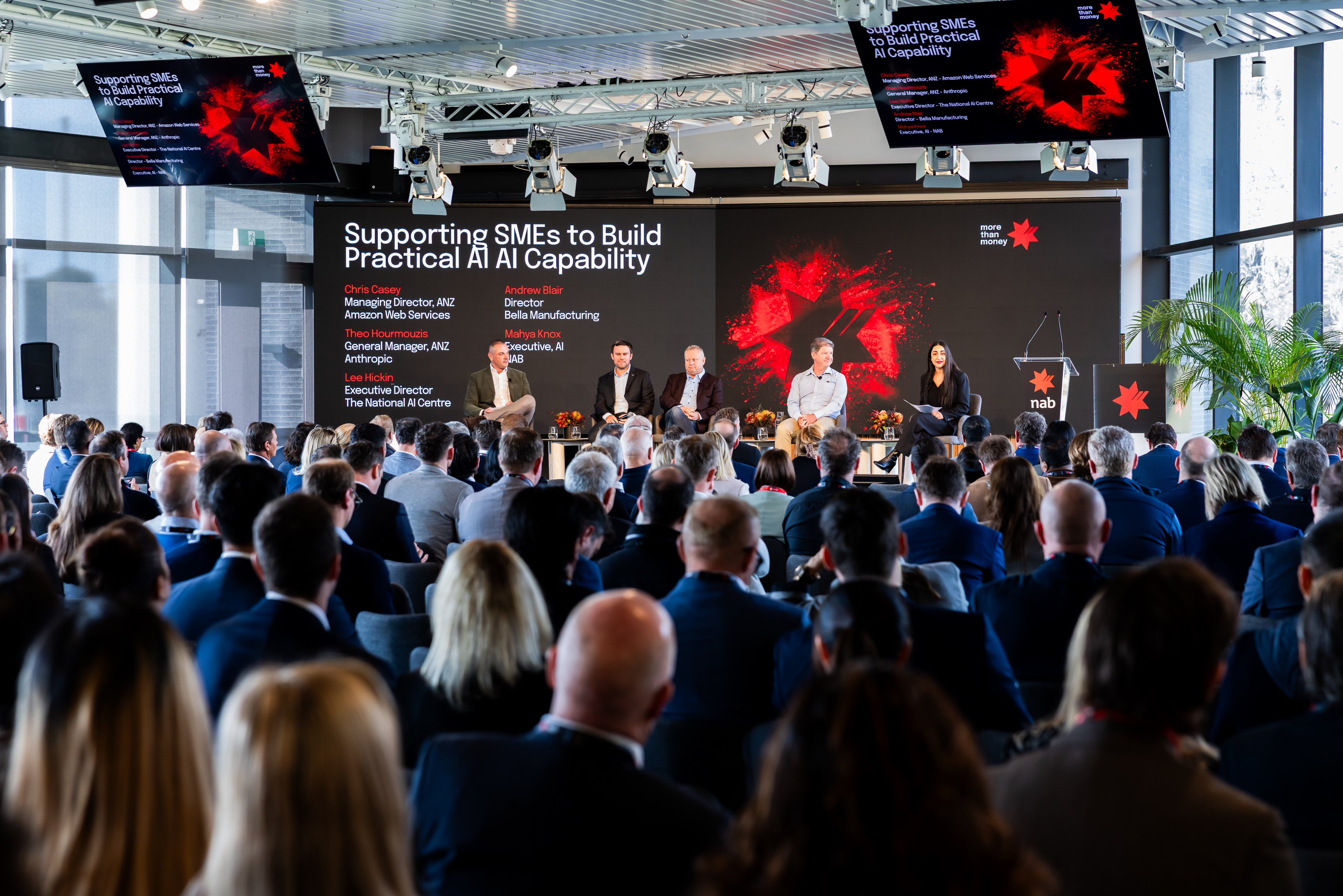
The NAB Small Business Summit

Start with the value

AI might help reduce repetitive work, speed up a process, find information faster or give someone a better starting point.

The value comes from what that enables.

It might mean more capacity to grow the business. Better service for customers. More time for work that needs judgement or experience. Or simply getting something done that hasn't been getting enough attention.

So before introducing AI, get clear about what you want to improve and what matters to you. Then ask whether AI can help. Sometimes it will. Sometimes a better process or a technology you already have will do the job.

The goal is not to find more places to use AI. It's to find the places where it can make a worthwhile difference.

Confidence matters too

Knowing where AI could help is one part of the equation. Feeling confident enough to use it is another.

NAB’s August research found 18% of small businesses said a free, short AI course would encourage them to try AI or become more confident using it.

That’s a useful signal for those of us working to support Australian businesses.

It’s also one of the reasons the National AI Centre is working with NAB to deliver practical AI education for its small business customers.

We want to help businesses get past the abstract conversation about AI and into the practical questions: Where could it help? How do I use it responsibly? And how do I know whether it’s creating value?

Know what better looks like

You don’t need a complicated measurement framework to answer that last question.

If you want to save time, know where the time is going now. If you want to improve customer service, decide what improvement would look like. If you want more capacity, know what you want to do with it.

That gives you something much more useful to measure than whether your business is simply 'using AI'.

Which brings me back to Andrew’s point.

The time it gives back is yours.

The interesting question is what you choose to do with it.